

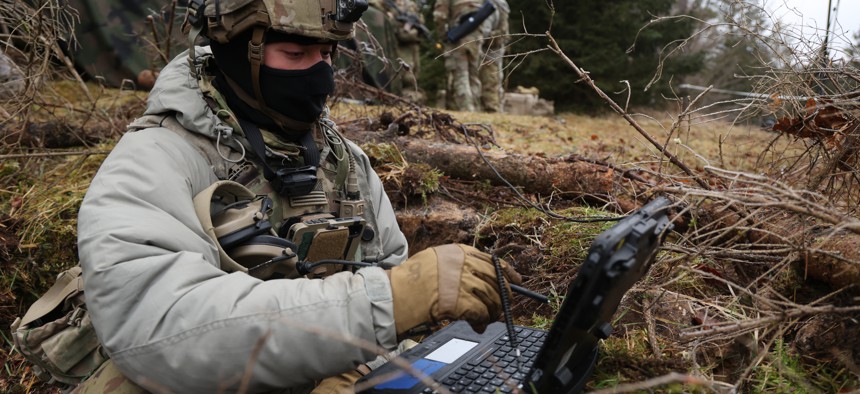
A 10th Mountain Division soldier operates a simulation of the Low Altitude Stalking and Strike Ordnance (LASSO) loitering munition during the Combined Resolve 25-1 exercise at the Hohenfels Training Area near Hohenfels, Germany, on February 3, 2025. Sean Gallup/Getty Images


As warfare becomes engineering, the era of the digital mercenary dawns
The White House revives “privateering for the digital age” by authorizing cyber firms to strike foreign targets.

Private cyber firms will be allowed to take action against foreign threats under a new White House policy, another step into a future where tech developers are ever more closely entwined with military operations, which now evolve faster than governments can keep up.
Under the policy, announced Wednesday, the U.S. government will pay private cybersecurity companies to “manipulate,” “degrade,” “disrupt,” and “destroy” foreign adversary computer networks. The U.S. government historically reserves the right to take those sorts of actions, although they increasingly do so with help from front-line private workers.
The companies will undergo vetting, be supervised by the departments of Justice and Homeland Security, and be forbidden to take actions that could “result in the loss of life or serious injury,” according to the presidential memo.
“The United States just revived privateering for the digital age,” wrote Jeff Gray, who led training for DHS’s emergency response team and currently leads incident response training with the Cybersecurity and Infrastructure Security Agency.
The phrase recalls the 17th and 18th centuries, when governments issued letters of marque that allowed swashbuckling sea captains to attack foreign merchant ships. That official authorization is what distinguished men like Captain Kidd and Henry Morgan as “privateers,” not pirates. But when they lost that marque, many, like Kidd, went on to be pirates anyway.
Gray acknowledges that the term isn’t a perfect fit; for one thing, letters of marque are granted by Congress, not the president. Nevertheless, he says, “The government is authorizing private actors to conduct offensive cyber operations on its behalf, under its control. That's privateering.”
The memo says hiring private hackers is only logical: “American businesses’ innovative capabilities have historically been underutilized” to “secure a critical offensive cyber advantage for the United States.”
Russia has been doing this sort of thing for years: enlisting, or coercing, private companies and groups to carry out cyberattacks against Western targets.
One cybersecurity exec said the policy makes sense, especially as AI gives adversaries more tools.
“There will be more cyberattacks for sure, so I do think you want to expand the takedown activity as well,” said the executive, a founder of a prominent U.S. cybersecurity firm that works with the U.S. government.
AI-assisted cyberattacks rose 89 percent in 2025, according to a February report from cybersecurity company CrowdStrike.
Gray also described the strategy as “strategically sound.” But he expects it to provoke a short-term increase in attacks, and over a longer timeframe, to cause adversaries to shift tactics, accelerate operations, and gain additional “cover” to hide their operations.
Finally, Gray noted that law-enforcement agencies have long hired private firms for this sort of work, particularly taking down botnets. “The work is still the same. But the environment just got more complicated,” he said.
The cyber exec agreed. “Instead of a law-enforcement person pushing the button, it will be a private-sector person,” said the company founder. “I expect every Israeli cyber startup to jump at the chance.”
Cyberops and physical war
The policy is the latest indication that software weapons are evolving to be as crucial as hardware on the modern battlefield—and that is putting private coders and weapon designers closer to real-world operations. In Ukraine, for example, engineers with drone maker Shield AI and other contractors work closely with soldiers, sometimes under fire, to modify weapons based on digital attacks.
The job of fighting is, more and more, becoming a job of engineering, said one former senior defense official we spoke to in 2025, just after Donald Trump returned to office. The official said that the Pentagon’s new leaders were considering a plan to let drone makers and other tech companies conduct operations under company-owned, company-operated agreements.
The idea was not without precedent. SpaceX operates the Starlink satellites that connect U.S. troops, rather than allowing U.S. personnel to do so. And under the first Trump administration, the Pentagon paid Anduril to maintain and update drones in the field, deploying along with special operations forces.
The official said putting engineers in the field is essential to getting new capabilities to the front lines faster.
“A lot of these technologies,” they said, are “super exquisite, they're fragile, they're very technical. The people that built them are the ones that know how they work.”
Having the weapons’ makers observe and even operate their products in the field reduced red tape in getting new designs approved, changed, or deployed.
The official last year acknowledged that most defense firms don’t operate that way, and federal law outlines boundaries on what defense contractors can and can’t do (engaging in combat is in the "can’t do" column). But ultimately, they said, “If you want capability in 2027 the only way you're going to get is if this happens.”
In April, CENTCOM hired Shield AI to provide intelligence, surveillance, and reconnaissance to U.S. forces with its V-BAT drone, under a contractor-owned, contractor-operated arrangement.
Brandon Tseng, Shield AI’s co-founder, said of the agreement: “We aren’t just bringing the V-BAT product and service to the Navy; we’re bringing a world-class team with a wealth of operational experience and the ability to produce undeniable outcomes for our warfighters.”