

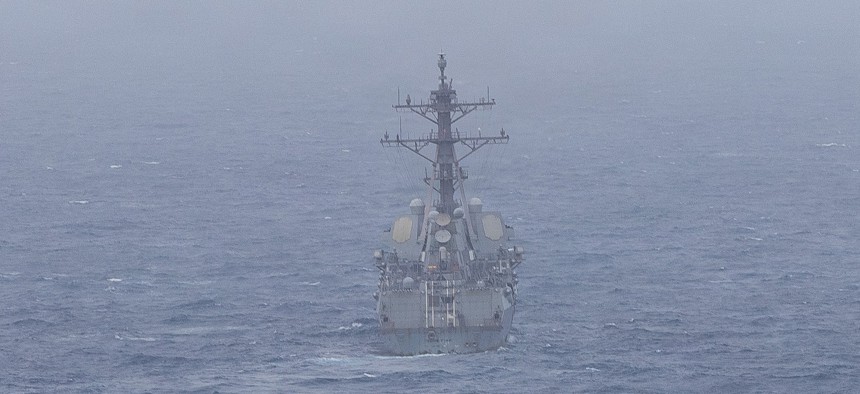
The Arleigh Burke-class guided-missile destroyer John Finn (DDG 113) sails in the Arabian Sea on June 16, 2026. U.S. Navy



Are yearlong deployments the Navy’s new normal?
That's what officials are telling sailors' families in Japan, where two destroyers are slated for 12- and 14-month cruises.

When the U.S. Navy destroyer John Finn left home in January, sailors expected to be home in March. Now, after extensions on top of extensions, their families have been told to expect them next March—after a 14-month deployment.
The Mustin, another Arleigh Burke-class destroyer, switched homeports this year, leaving San Diego in February and arriving in Yokosuka, Japan, in March. As the sailors stepped off the ship, they were told they needed to be ready to deploy “tomorrow.”
The Mustin actually left Japan in April for a deployment that was supposed to end in August. Now its crew has been told they will return in April 2027, the spouse of one of the sailors told Defense One.
These marathon deployments—a month or more longer than the carrier Abraham Lincoln’s record-breaking 322 days—may be the new normal for U.S. warships. Last week, a Navy official told families at Yokosuka that all ship deployments and patrols, stateside and overseas, will be 10 to 12 months long for the foreseeable future.
Asked about that statement, a Navy spokesperson told Defense One, “It is U.S. Navy policy not to discuss future operations or movements due to operations security.”
But last month, Chief of Naval Operations Adm. Daryl Caudle said that sailors and their families should expect “longer deployments” until “I can grow the Navy we need.” The service’s battle force currently consists of about 290 warships, down from 295 two years ago but up from about 275 a decade ago.
In recent decades, the Navy has generally kept deployments to six or seven months, although that is not a set-in-stone policy, said Katherine Kuzminski, vice president of studies at the Center for a New American Security. But, she said, “that commitment is being violated now.”
“Certainly, depending on operational needs and demands, I think service members and their families are fully on board with providing—with the requirements that are put on them in ongoing operations,” Kuzminski said. “A potential way that the Navy can mitigate this is actually to just commit to the longer term upfront and be clear with service members and their families.”
After initial reports of the Lincoln’s woes emerged, some veterans of other services and other conflicts were quick to post online about their own longer deployments. But the issue, Kuzminski said, is not so much the length of the deployment, but the “dissonance between what was said at the beginning and what is happening in actuality.”
That dissonance is particularly pronounced for the John Finn, one of several “forward deployed” guided-missile destroyers based at Yokosuka. While other Navy ships tend to deploy for about six months and then return home for a year, forward-deployed ships typically leave for two or three months at a time, then return to port for two to three months of maintenance before heading back out to sea. Those deployments are designed to keep the ships ready for combat in the region, deter aggression from China, and “maintain a free and open Indo-Pacific.”
Last year, the John Finn left home in June for a “normal” deployment in the region and returned in early November. But much of the following two months were spent in hasty preparations to return to sea.
“We really only saw him a collective 20 days,” the spouse of a sailor on the ship told Defense One.
In early January, the ship left again, for what was expected to be a deployment of perhaps 45 to 60 days. It headed to the Indian Ocean and was involved in the boarding of a Venezuelan oil tanker before being directed to the Arabian Sea, shortly before Operation Epic Fury began.
The ship was part of the initial attack on Iran, the spouse said, and they’re “still there.”
Earlier this month, the sailors were told they would likely not be home until March 2027.
“There’s cars that were left on base that have been stickered to be towed and then to be junked. So there’s sailors that are going to come back and have no cars,” the spouse said. “They left in the winter months, and there’s some sailors that live off base and are single sailors and will have abandoned their entire house, their apartment, for over a year. And when they left in the winter months, when they left everything on heat mode, and then the summer came.” Sailors know “that they’re going to come home and all their stuff will be trashed.”
For families, it’s more than a year without a parent—without any of the planning for a long deployment.
“It’s been absolutely gut-wrenching to my kids,” the spouse said, and there is “next to no mental health support” available on base. The deployment length is “absolutely unheard-of for a destroyer,” she said.
The Finn’s story is extreme—but not unique among Yokosuka-based destroyers.
Photos posted on the Pentagon’s DVIDS media site show the Rafael Peralta in the Philippine Sea in November, in the South China Sea in December, and back in the Philippine Sea on Jan. 8. Then, instead of returning home, it headed for the Middle East in April, where it remains today. Families have been told not to expect the ship home until April 2027.
The Higgins, which lost power and propulsion for a few hours in the Indo-Pacific in April, continued its deployment after repairs and is currently operating in the Indian Ocean. The Milius left Japan in February and has been in the Middle East since March.
The Mustin left its old homeport of San Diego in February and arrived in Japan in March. Sailors are usually given 30 days to help their families move and settle in for a homeport shift, particularly when the move is to a foreign country, and the majority of the families had waited until the ship arrived to make the move. But “the moment they pulled in, my husband stepped off the ship, and he goes, ‘We have to be prepared to leave tomorrow,” a Mustin spouse told Defense One.
The ship did stay in its new port for a few weeks because of a sonar problem that required an expert to fly in to fix it, but sailors did not get time off during that time frame because they needed to be ready at a moment’s notice, the spouse said. They left in April with the expectation that they would return in August and then go out again over the holidays before monthslong scheduled maintenance beginning in February.
But when August came, the ship’s commander told the sailors they would be out for “about another month,” the spouse said. A few weeks ago, they were told they wouldn’t be home until April 2027.
The situation is all the more frustrating for sailors and families because the ship has spent virtually the entire deployment in the Indian Ocean as “backup.”
“They’re not in the blockade, they’re like the next in line, just out there waiting,” she said.
The distinction means that the Mustin sailors don’t get combat pay or benefits.
“I know they feel forgotten about,” she said.
The John Finn spouse said it has been frustrating for families and sailors to read all the media coverage of the Lincoln’s long deployment, while knowing that other ships supporting her were “left behind.”
“I can do a long deployment,” she said. “The problem with this is that there is no answer as to when this will be over. … Why are we not rotating ships? And then why are we there? Why are you sending home stateside ships before your forward deployed ships?”
In response to questions about why the ships have not been replaced, a Navy spokesperson said, “The Department takes a thoughtful and deliberate approach to global force management, continually balancing immediate operational requirements against risks across theaters.”
If longer deployments increasingly become the norm, Kuzminski said, it’s important that the Navy be upfront with sailors and their families about what to expect.
But the situation highlights another problem: The Navy doesn’t have a confirmed civilian secretary, “a person who is fundamentally the accountability to Congress on how things are working,” she said.
Without a Navy secretary, she said, it’s hard to answer the big questions: “Is this the new normal? How are you handling that? How are we preparing sailors for that? How are we preparing their families for that? How are we preparing our ships for that?”